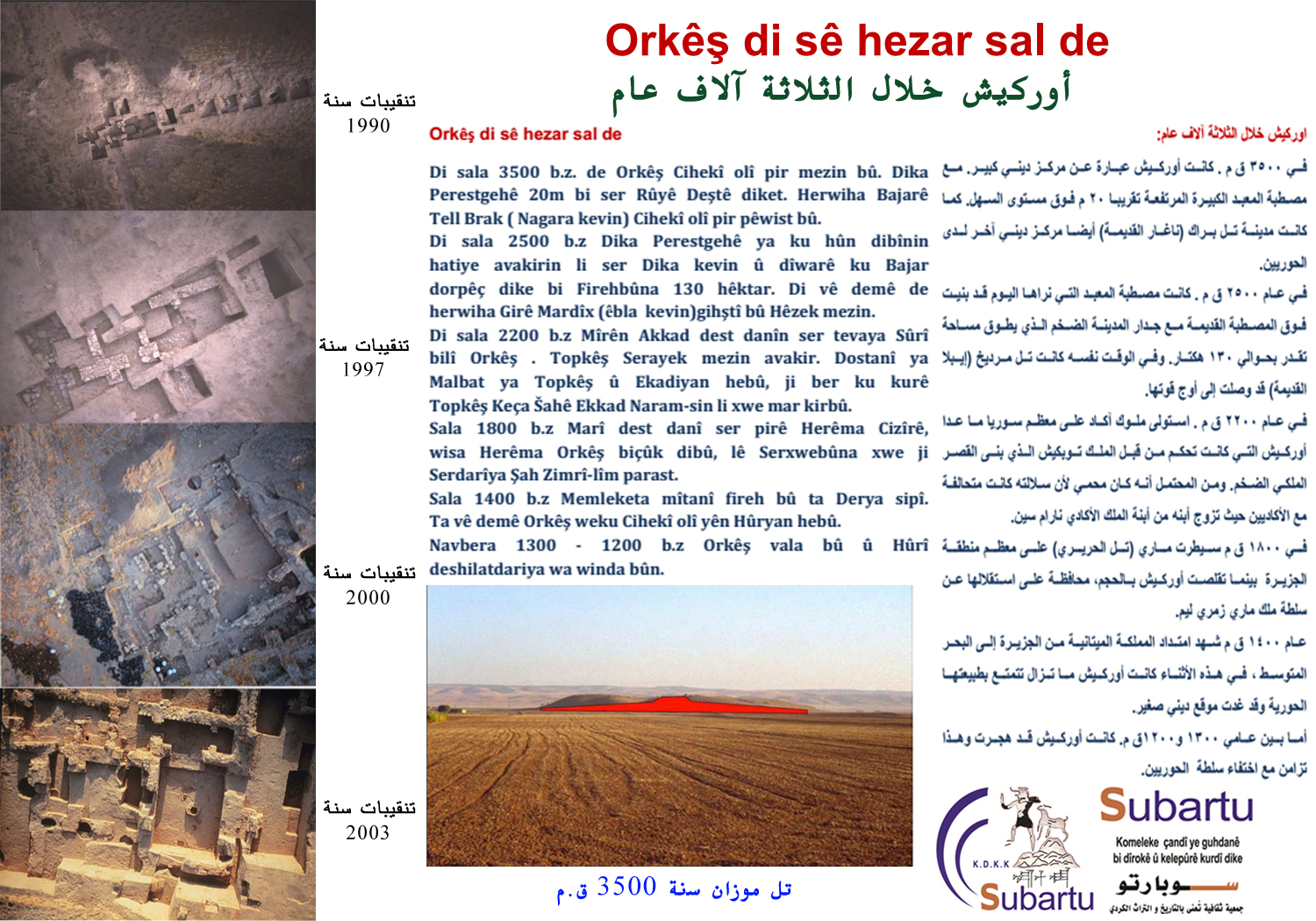
Urkesh during three thousand years: In 3500 B.C, Urkesh was a big religious center, with a big temple terrace, 20 meters high above the plain level. The city of Tell Brak (ancient Nagar) was also another Hurrian religious center. In 2500 B.C, the temple terrace we see today, was built on top of an older terrace, with a big wall surrounding the 130 hectares. At the same time, Tell Mardikh (ancient Ebla) reached its full power. In 2200 B.C., the kings of Akkad controlled most of Syria, except Urkesh. It was ruled by king Tupkish who build the great royal palace. It is probable that he was protected because his dynasty was allied with the Akkadians through the marriage of his son with the daughter of the Akkadian king Naram-Sin. In 1800 B.C, Mari (Tell Hariri) controlled most of the Jazira area, and Urkesh shrunk in size, retaining its independence from the power of Zemri-Lim, the ruler of Mari.
In 1400 B.C, The mittani kingdome expanded from Jazira to the Mediterranean sea, meanwhile, Urkesh was still Hurrian, but it became a small religious center.
Between 1300 and 1200 B.C., Urkesh was abandoned, and this coincided with the disappearance of the Hurrian power.
Mozan in 3500 B.C.